Tuesday, April 19, 2011

The House in the Night


Review of The House in the Night ill. by Beth Krommes, by Susan Marie Swanson From Booklist

A young girl is given a golden key to a house. “In the house / burns a light. / In that light / rests a bed. On that bed / waits a book.” And so continues this simple text, which describes sometimes fantastical pleasures as a bird from the book spirits the child through the starry sky to a wise-faced moon. The cumulative tale is a familiar picture-book conceit; the difference in success comes from the artwork. Here, the art is spectacular. Executed in scratchboard decorated in droplets of gold, Krommes’ illustrations expand on Swanson’s reassuring story (inspired by a nursery rhyme that begins, “This is the key of the kingdom”) to create a world as cozy inside the house as it is majestic outside. The two-page spread depicting rolling meadows beyond the home, dotted with trees, houses, barns, and road meeting the inky sky, is mesmerizing. The use of gold is especially effective, coloring the stars and a knowing moon, all surrounded with black-and-white halos. A beautiful piece of bookmaking that will delight both parents and children. Preschool-Kindergarten. --Ilene Cooper

I wanted to take the illustrations in this book and frame them for the wall. Each page was so visually appealing, it drew you in. The simplicity of the illustrations coupled with the simplicity of the words, made the book a joy for a bedtime story. The attention to detail was especially appreciated when my oldest looked for markings in the first house in the beginning so she could find it in the town at the end of the book. It is a must have once again for the elementary library and may even be able to be used with older students because of the style of the illustrations being so unique in children's literature.

The Lion and the Mouse


Review of The Lion & the Mouse by Jerry Pinkney From School Library Journal

This story starts on the cover with the glorious, golden countenance of a lion. No text is necessary to communicate the title: the direction of the beast's gaze and the conflicted expression on his tightly cropped face compel readers to turn the book over, where a mouse, almost filling the vertical space, glances back. The endpapers and artist's note place these creatures among the animal families of the African Serengeti. Each spread contributes something new in this nearly wordless narrative, including the title opening, on which the watchful rodent pauses, resting in one of the large footprints that marches across the gutter. In some scenes, Pinkney's luminous art, rendered in watercolor and colored pencil, suggests a natural harmony, as when the cool blues of the sky are mirrored in the rocks and acacia tree. In other compositions, a cream-colored background focuses attention on the exquisitely detailed and nuanced forms of the two main characters. Varied perspectives and the judicious use of panels create interest and indicate time. Sounds are used sparingly and purposefully—an owl's hoot to hint at offstage danger or an anguished roar to alert the mouse of the lion's entrapment. Contrast this version with Pinkney's traditional treatment of the same story (complete with moral) in Aesop's Fables (North-South, 2000). The ambiguity that results from the lack of words in this version allows for a slower, subtle, and ultimately more satisfying read. Moments of humor and affection complement the drama. A classic tale from a consummate artist.—Wendy Lukehart, Washington DC Public Library

This book was an almost wordless book. My younger daughters needed some explaining so they would understand what was happening. My oldest daughter realized it was a fable she had read at school and was happy to offer her expertise! The illustrations were beautiful and it was obvious why this book won a Caldecott award. The pages almost seemed real, as if the animals could jump out of the pages. This book is another must have for the library, not only because it won an award, but because it would be well loved by students and teachers alike!

A Sick Day for Amos McGee


Amazon.com Review of A Sick Day for Amos McGee illustrated by Erin E. Stead by Philip C. Stead

THE BEST SICK DAY EVER and the animals in the zoo feature in this striking picture book debut.

Friends come in all sorts of shapes and sizes. In Amos McGee’s case, all sorts of species, too! Every day he spends a little bit of time with each of his friends at the zoo, running races with the tortoise, keeping the shy penguin company, and even reading bedtime stories to the owl. But when Amos is too sick to make it to the zoo, his animal friends decide it’s time they returned the favor.

This was a sweet story that held the interest of all 3 girls (3, 4, and 7 years old). Amos seems as if he could be grandpa sitting right next to you with his gentle demeanor and kind heart. It is as if he is the grandfather to the animals at the zoo. The humor of the animals catching the bus and having an overnight at Amos' home was well received by the young readers! This is a darling book for the early elementary library.

Friday, April 15, 2011

Week 9: Caldecott Winners

Week 9: March 23-29
Caldecott Winners
http://www.ala.org

1. 2011: A Sick Day for Amos McGee illustrated by Erin E. Stead by Philip C. Stead
2. 2010: The Lion & the Mouse by Jerry Pinkney
3. 2009: The House in the Night ill. by Beth Krommes, by Susan Marie Swanson
4. 2008: The Invention of Hugo Cabret by Brian Selznick
5. 2007: Flotsam by David Wiesner
6. 2006: The Hello, Goodbye Window Ill. by Chris Raschka, by Norton Juster
7. 2005: Kitten's First Full Moon by Kevin Henkes
8. 2004: The Man Who Walked Between the Towers by Mordicai Gerstein
9. 2003: My Friend Rabbit by Eric Rohmann
10. 2002: The Three Pigs by David Wiesner
11. 2001: So You Want to Be President? Ill. by David Small; by Judith St. George
12. 2000: Joseph Had a Little Overcoat by Simms Taback (Viking)
13. 1999: Snowflake Bentley, Ill. by Mary Azarian; by Jacqueline Briggs Martin ·
14. 1998: Rapunzel by Paul O. Zelinsky
15. 1997: Golem by David Wisniewski
16. 1996: Officer Buckle and Gloria by Peggy Rathmann
17. 1995: Smoky Night , illustrated by David Diaz; text: Eve Bunting
18. 1994: Grandfather's Journey by Allen Say; text: edited by Walter Lorraine
19. 1993: Mirette on the High Wire by Emily Arnold McCully
20. 1992: Tuesday by David Wiesner
21. 1991: Black and White by David Macaulay
22. 1990: Lon Po Po: A Red-Riding Hood Story from China by Ed Young

Rationale:
These are always some of the most popular books checked out of my school library. They have their own shelves and the children are drawn to them. I wanted to look at them in a historical perspective and see if there are shared qualities through the years. I have also read many of them trough the years and thought it would be good to be reintroduced to them.

The Graveyard Book


The Graveyard Book by Neil Gaiman, illus. by Dave McKean Reviewed From School Library Journal:
Somewhere in contemporary Britain, "the man Jack" uses his razor-sharp knife to murder a family, but the youngest, a toddler, slips away. The boy ends up in a graveyard, where the ghostly inhabitants adopt him to keep him safe. Nobody Owens, so named because he "looks like nobody but himself," grows up among a multigenerational cast of characters from different historical periods that includes matronly Mistress Owens; ancient Roman Caius Pompeius; an opinionated young witch; a melodramatic hack poet; and Bod's beloved mentor and guardian, Silas, who is neither living nor dead and has secrets of his own. As he grows up, Bod has a series of adventures, both in and out of the graveyard, and the threat of the man Jack who continues to hunt for him is ever present. Bod's love for his graveyard family and vice versa provide the emotional center, amid suspense, spot-on humor, and delightful scene-setting. The child Bod's behavior is occasionally too precocious to be believed, and a series of puns on the name Jack render the villain a bit less frightening than he should be, though only momentarily. Aside from these small flaws, however, Gaiman has created a rich, surprising, and sometimes disturbing tale of dreams, ghouls, murderers, trickery, and family.—Megan Honig, New York Public Library
Copyright © Reed Business Information, a division of Reed Elsevier Inc. All rights reserved.

I listened to the audio book version of this with my husband. It was interesting to see how we heard the story differently. First, I spent he first few chapters explaining what was happening, who each character was, and if they were dead or alive. He tends to read more nonfiction and was confused by so many character and keeping track of how the interlocked through the story. Once he got that down, I think he liked the book even more than I did! We had 2 chapters left after a long car trip and he had to ask when we were going to read again so he could hear the ending! That says a lot coming from a guy who says he "doesn't like fiction".

It was a fantastic book. The characters were lovable and easy to connect to. You really wanted the best for Bod and to make sure he was protected. I loved the idea of being in a graveyard and being able to learn to do what they do, like "fading". It was also clever the way he wove character of different age level into the graveyard so Bod always had someone to befriend that was close to his current age. The plot was fantastic from the exciting beginning with a baby escaping a murder and being taken in by ghosts in a graveyard to the new beginning for Bod in the end. A must have for the middle or high school library.

When You Reach Me


When You Reach Me by Rebecca Stead a review From School Library Journal:
Miranda lives in 1978 New York City with her mother, and her life compass is Madeleine L'Engle's A Wrinkle in Time. When she receives a series of enigmatic notes that claim to want to save her life, she comes to believe that they are from someone who knows the future. Miranda spends considerable time observing a raving vagrant who her mother calls the laughing man and trying to find the connection between the notes and her everyday life. Discerning readers will realize the ties between Miranda's mystery and L'Engle's plot, but will enjoy hints of fantasy and descriptions of middle school dynamics. Stead's novel is as much about character as story. Miranda's voice rings true with its faltering attempts at maturity and observation. The story builds slowly, emerging naturally from a sturdy premise. As Miranda reminisces, the time sequencing is somewhat challenging, but in an intriguing way. The setting is consistently strong. The stores and even the streets–in Miranda's neighborhood act as physical entities and impact the plot in tangible ways. This unusual, thought-provoking mystery will appeal to several types of readers.–Caitlin Augusta, The Darien Library, CT

I did not like this book at all. First, I did not attach to the characters. Miranda just seemed confused for most of the book and never really found herself, though she did solve the mystery. Marcus was a mystery the entire book then all of a sudden he is a time traveler, yet it never really says how. The story was too far fetched for me also and honestly a bit hum-drum and boring. It was also confusing with all of the references to A Wrinkle In Time, when I have never read that book. On a side note, I also listened to the audio book version and the reader's voice was NOT one I would have chosen for the book. She was very robotic with a monotone affect and she had a hoarse voice. It made this already dull book, even harder to get through. I don't understand how it became a Caldecott Award Winner. I really don't think that kids would connect with this story. I would put it in the library, but I may not recommend it often.

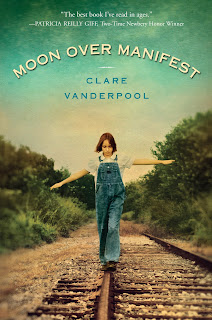
Moon Over Manifest


A review of Moon Over Manifest by Clare Vanderpool From School Library Journal
History and fiction marry beautifully in this lively debut novel. It's as if readers jump off the train in Manifest, KS, in 1936 with Abilene Tucker, 12, the feisty, likable, and perceptive narrator. She is there to live with Pastor Shady Howard, her father's friend, while her father works on the railroad back in Iowa. An equally important story set during World War I is artfully intertwined. Since her mother went off on her own 10 years earlier, Abilene and Gideon have been alone. Though their life together is unsettled, their bond is strong. Shady's place is shabby, but he is welcoming. The mystery about Manifest and Gideon unfolds after Abilene finds a box filled with intriguing keepsakes. It includes a letter dated 1917 to someone named Jinx from Ned Gillen that has a warning, “THE RATTLER is watching.” This starts Abilene, with the help of new friends Ruthanne and Lettie, on a search to learn the identity of the pair. The story cleverly shifts back and forth between the two eras. Abilene becomes connected to Miss Sadie, a “diviner” who slowly leads her through the story of Ned and Jinx. Though the girl is lonely, she adjusts to her new life, feeling sure that her father will come for her at summer's end. The Ku Klux Klan and its campaign against the many immigrants working in the coal mines and the deplorable conditions and exploitation of these men provide important background. This thoroughly enjoyable, unique page-turner is a definite winner.–Renee Steinberg, formerly at Fieldstone Middle School, Montvale, NJ

I really enjoyed this book, though did find it fairly predictable with a few surprises. I do wonder how much appeal it will have to younger readers. The history drew me in and had me rooting for the underdog. Storyline was easy to follow and the characters were believable. I think strong readers would like the book, but as with many historical fiction books, this one may not have full appeal to the readers of today.